Total New Ups grew year-over-year in November 2025 — entirely from 47 new store openings. The 242 stores that were open a year ago lost more than 10% of their customer volume. Every headline celebrating system growth is quietly papering over a same-store business that is shrinking.
Total system New Ups grew 7.2% year-over-year in November 2025 — a number the team has every right to celebrate. But the headline is a blend of two opposing forces. On one side: 47 new store openings adding fresh traffic at the top of the system. On the other: 242 existing locations quietly losing 10.7% of their customer volume.
Any strategy judged on total system New Ups alone will optimize for the wrong outcome. Growth that depends on adding doors faster than existing doors lose customers is structurally fragile — and the fragility compounds.
Every number on this page is sourced to a document The Good Feet Store team provided in the RFP package. Nothing here is agency estimation dressed as insight. The evidence is corroborated across three independent sources that triangulate the same conclusion.
Reports the year-over-year split directly: total system New Ups +7.2% vs. same-store −10.7%. The gap is entirely explained by 47 new stores added in the prior 12 months.
Net Sales per New Up held in the $665–$760 band across 2025. When sales improvements are traffic-driven and traffic is declining in same-store markets, the business has no backstop.
Across Extra Large, Large, Small, and Extra Small DMAs, digital spend shows no statistically significant positive correlation with New Up volume. Digital captures demand — it does not create it. The demand itself is softening.
The same-store decline is not a single number. It is a set of compounding effects — lost revenue in the current year, accelerating loss in the next, and an eroding floor underneath the whole system. Each one has a different fix, and each one pays back on a different timeline.
242 same-store locations × 10.7% decline × ~350 New Ups/store × $700 NSNU. This is the revenue the existing store base gave up in 2025 alone — before any 2026 acceleration, before any compounding, before any new opening outpaces the floor.
New store openings add revenue linearly. Same-store decline compounds against a larger base. If the 2026 decline accelerates to 15%, the same-store gap widens to roughly $9M annually — and the number of new stores required to paper over it grows at the same pace.
At current pace, 47 new openings per year fill the same-store gap and generate headline growth. But every new opening is a real estate decision, a franchisee commitment, and a capital requirement — and the underlying unit economics of each new store depend on the awareness baseline the same-store problem is eroding.
The bill already paid. 242 existing locations × 10.7% decline × 350 NUs × $700 NSNU. Recorded, booked, and absorbed by the new-store tailwind.
Arrest the decline and shift to modest growth in 40% of TV-active DMAs. Combination of national TV reach, CTV extension, and non-brand search activation in the 30 dark markets.
Same-store volume returns to pre-decline levels across the majority of DMAs. The system now grows on both the new-store engine and the same-store engine simultaneously — a structurally different business.
The goal is not "more stores." The goal is more qualified customers into every existing store — and then more stores, supported by a same-store base that is actually growing.
Jekyll + Hyde protects and extends the national TV buy that reversed the 2H 2025 decline. Ryze activates the digital layers that linear TV cannot reach — CTV for streaming homes, non-brand search for problem-based intent, Meta prospecting for category audiences. Together, we shift the growth engine from "open more doors" to "fill every existing door."
The national TV buy launched in July 2025 reversed a two-year seasonal decline pattern. CPO improved −6% H1→H2 while local spend was down. That is the single strongest same-store demand signal in the entire document set — and it is Jekyll + Hyde's work. The priority is to sustain it, extend it into underpenetrated DMAs, and license the creative for digital amplification.
Every unit of demand the national TV buy generates in same-store markets needs to land somewhere. Ryze activates the four digital layers that either (a) extend reach into audiences linear TV cannot touch, or (b) capture TV-created intent before it leaks to a competitor. All four are live within 90 days.
Three primary KPIs drive the intervention and define success. Four supporting KPIs surface the diagnostic detail that tells us why a metric is or isn't moving. All seven feed one shared dashboard that both agencies access and the client owns.
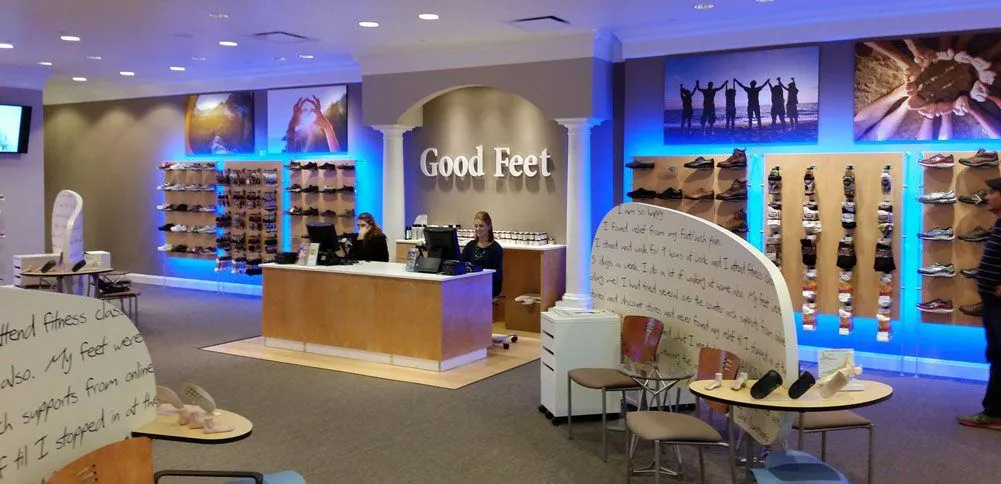
Existing stores running at full capacity. Customers walking back into brand-aware DMAs. A business that grows on two engines.
Same-store recovery isn't an abstract metric. It's the family that lives a mile from one of your 242 existing stores, sees the TV spot, searches the problem on their phone, gets served the right answer, walks in, and walks out with their first The Good Feet Store arch supports. Multiply that by 350 per store per year, across 242 stores, across 135 DMAs — and the system stops needing to open its way to growth. It grows on both the new-store engine and the same-store engine, simultaneously. That is a structurally different, structurally stronger business.